In our previous piece, we established that AI infrastructure carries a measurable environmental cost — and that the industry needs to operate differently.
The question that separates organisations that will lead from those that will lag is straightforward: what does an intelligently operated data centre actually look like? The answer is not more efficient hardware or better refrigerants. It is a fundamental shift in the operational logic that governs how facilities respond to the environments they inhabit. In 2026, that shift has a name: agentic AI in data centres.
A Market Growing Faster Than the Infrastructure Can Adapt
The global data centre cooling market, valued at approximately $22 billion in 2024, is projected to reach anywhere between $100 billion and $248 billion by 2034–2035. Even at the conservative end, this is a market more than quadrupling in a decade. And behind that number is a problem that investment alone will not solve.
According to the International Energy Agency, data centre electricity demand is expected to more than double, reaching approximately 945 TWh by 2030. Cooling systems, historically responsible for 30 to 40 per cent of total facility energy consumption, will scale in proportion unless operators make a deliberate break from how cooling has traditionally been managed.
The pace at which compute density is rising — driven by GPU-accelerated AI workloads — is outrunning the capacity of conventional, rule-based facility management. Static thresholds and scheduled maintenance cycles were designed for predictable environments. Modern AI-era data centres are anything but.
Why Reactive Cooling Is a Structural Failure, Not an Operational One
Hardware matters. But hardware alone does not explain why facilities with modern infrastructure still exhibit PUE values far above what their equipment specifications would suggest is achievable.
The deeper issue is temporal mismatch. Cooling loads shift over minutes, ambient conditions change over hours, and equipment degradation unfolds over weeks. Traditional building management systems operate on static setpoints and scheduled audits — responding to conditions that have already occurred rather than conditions that are about to emerge. The result is overcooling during low-density compute periods, localised hotspot formation, and compressor cycling inefficiency — all of which increase energy consumption without any corresponding gain in reliability.
Cooling is not a static engineering problem. It is a continuous optimisation problem, changing on the timescale of minutes, influenced by workload patterns, ambient conditions, equipment health, and grid carbon intensity simultaneously. The only class of system designed to operate at that timescale is an AI-driven one.
Adding urgency: the European Parliament’s 2025 briefing confirmed that data centre operators are now required to report annually against energy KPIs — PUE, total consumption, renewable energy share — with further requirements expected in 2026. Organisations that cannot demonstrate runtime optimisation will struggle to satisfy these mandates with post-hoc analysis.
Agentic AI: From Suggestion Engine to Autonomous Infrastructure Layer
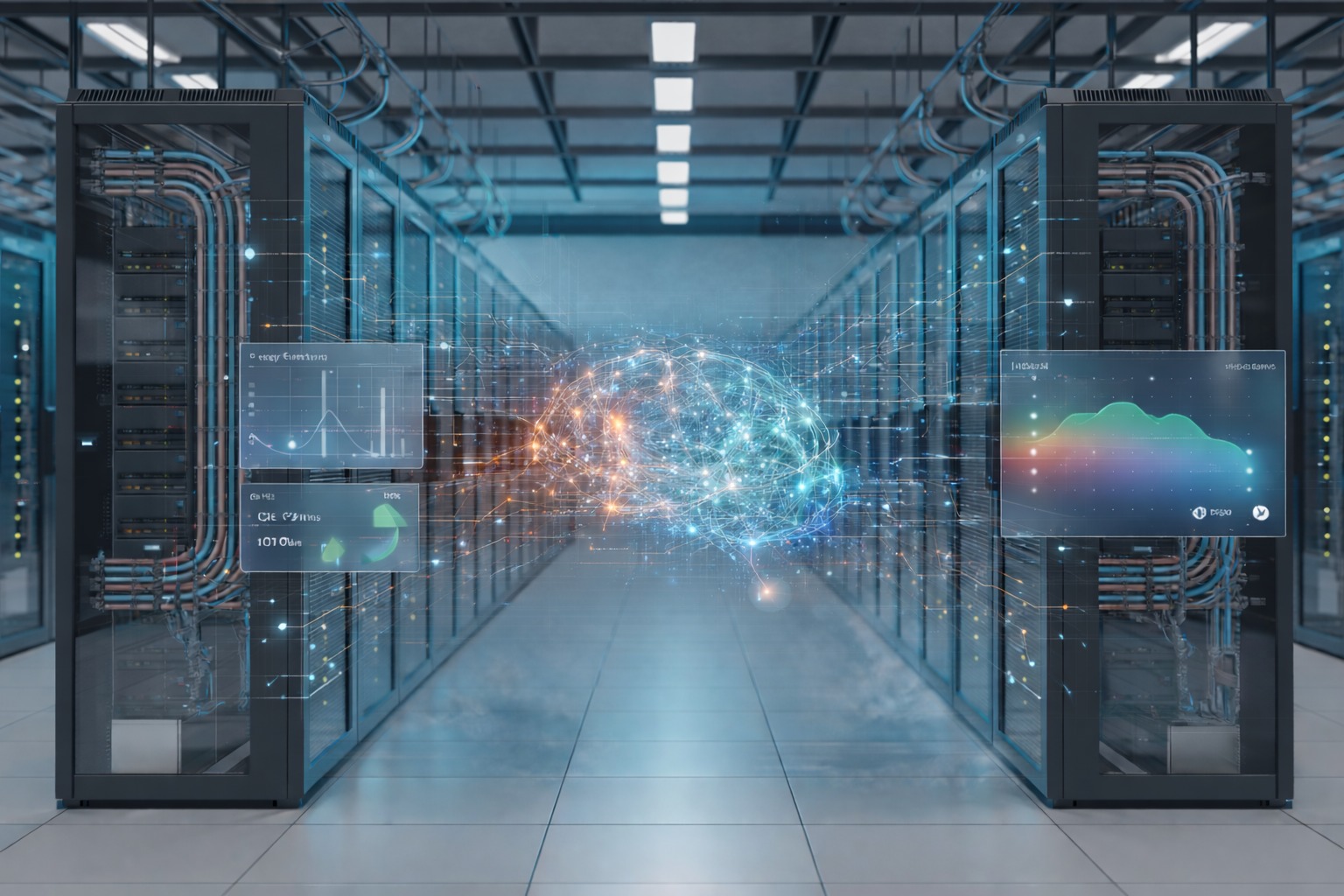
The distinction between conventional AI-assisted management and agentic AI is architectural, not incremental. Conventional AI systems observe, analyse, and recommend. Agentic AI systems observe, decide, and act — continuously, within defined safety boundaries, without waiting for human approval on each intervention.
The proof is already established at scale. Google DeepMind’s published results demonstrated a consistent 40 per cent reduction in cooling energy consumption, translating to a 15 per cent improvement in overall PUE — the lowest ever recorded at the target facility. When the system evolved from recommendation-based to autonomous control, sustained savings of approximately 30 per cent were achieved across multiple live facilities, improving further as the model accumulated operational data. As one Google data centre operator put it: “Rules don’t get better over time. AI does.”
What makes agentic AI different from prior automation is closed-loop adaptation. The system continuously refines its understanding of a facility’s thermal dynamics, incorporating the outcomes of its own actions as a training signal. In environments where every degree of uncontrolled temperature rise carries a measurable cost, this self-improving quality is not a luxury — it is the core value proposition.
Demand Forecasting: Operating in the Future, Not the Present
Agentic AI operates most effectively when paired with accurate demand forecasting — the ability to model what a facility will require before those requirements materialise. The practical implications span three domains.
First, workload-thermal alignment: predicting when compute density will peak allows operators to pre-position cooling capacity rather than react after conditions develop. Second, grid carbon alignment: integrating demand forecasts with carbon intensity data enables non-urgent workloads to be scheduled during periods of higher renewable availability. Third, maintenance optimisation: predictive models trained on equipment telemetry can identify degradation signatures days or weeks before failure — enabling interventions timed to minimise disruption.
The agentic AI energy market, valued at $656 million in 2025, is projected to reach nearly $15 billion by 2035 at a CAGR of 36.65 per cent. The organisations driving that growth are not doing so speculatively — they are responding to operational realities that conventional systems have proven unable to address.
What This Looks Like in Practice
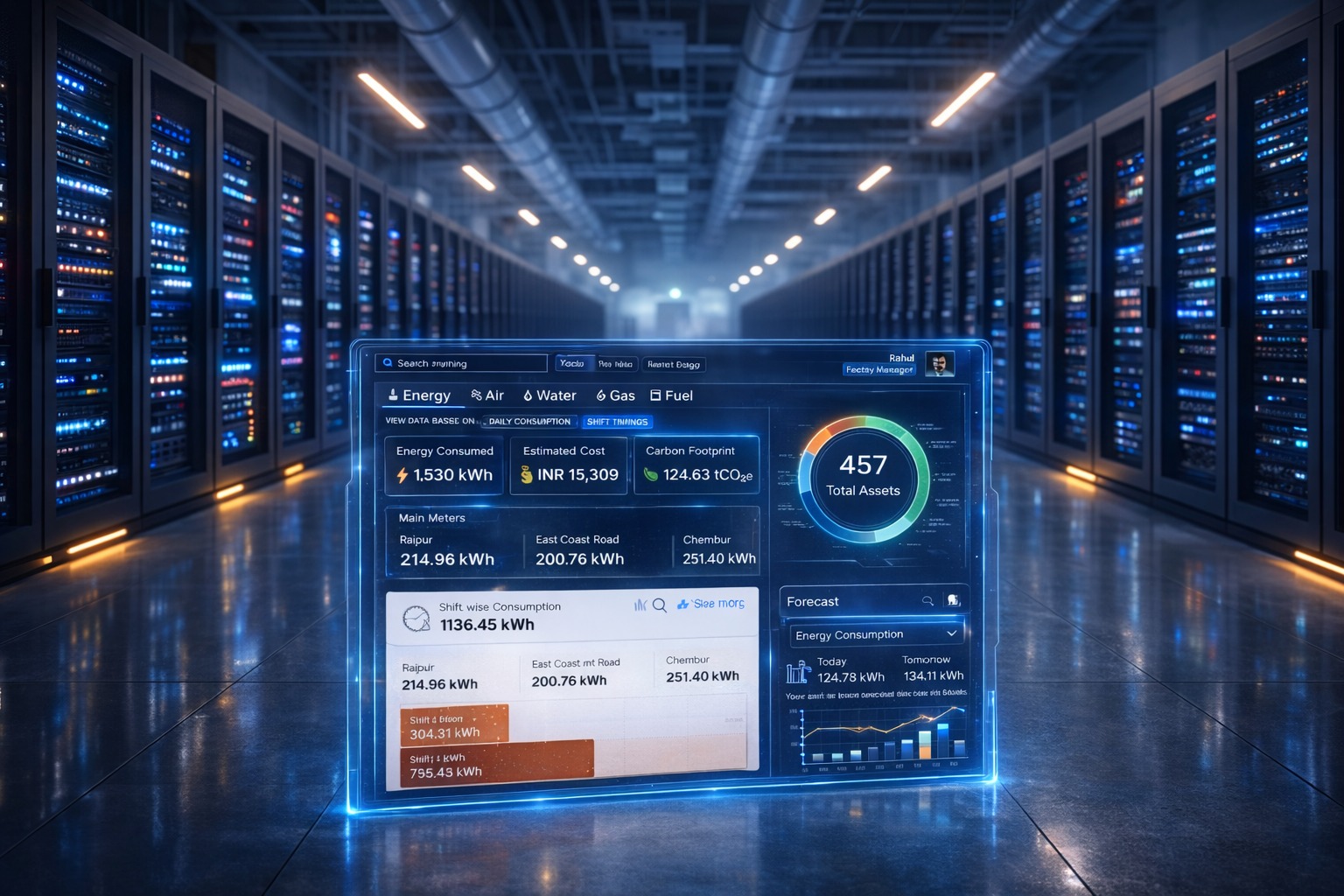
AOne is built on the premise that data centre infrastructure can be operated with the same intelligence that it hosts. Rather than layering AI recommendations onto existing BMS workflows, AOne functions as an autonomous operational layer — ingesting real-time telemetry, modelling future demand states, detecting anomalies before they become incidents, and continuously adjusting operating parameters to maintain efficiency at the facility scale. PUE and WUE optimisation are runtime objectives, not annual reporting metrics.
The cooling crisis in data centres is, at its core, an intelligence problem. And intelligence is something we now know how to deploy.
If this is the direction your organisation is moving, we’d be glad to show you what it looks like in practice.