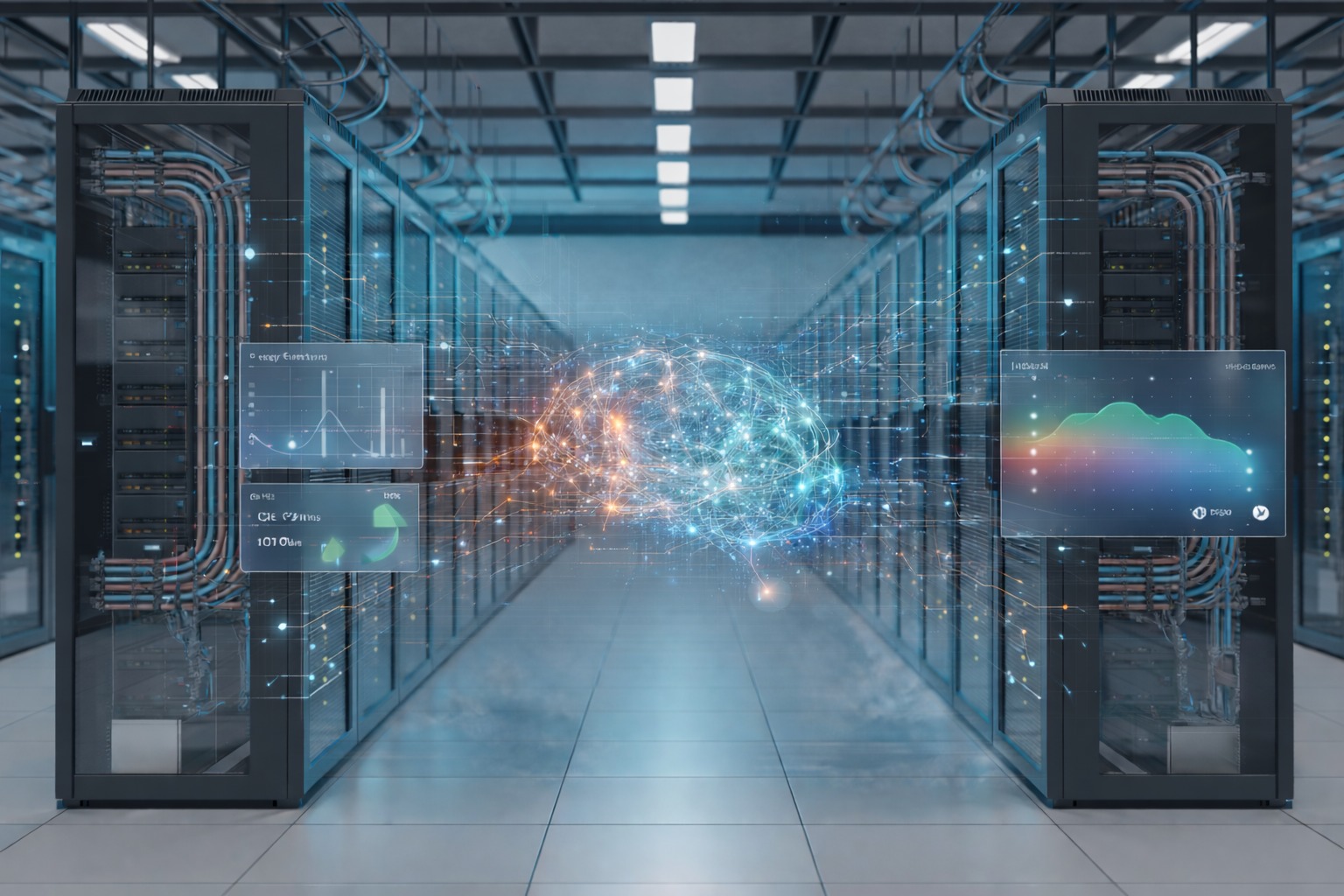

There is a growing narrative that Artificial Intelligence will play a pivotal role in building a more sustainable future, from optimising renewable energy distribution to enabling more efficient supply chains and reducing waste across industries. While this is directionally true, it leaves out a critical part of the equation that we are only beginning to confront at scale: AI is no longer just software. It is infrastructure.
Modern AI systems are supported by high-density compute clusters, industrial cooling systems, grid-connected power distribution, and water-intensive thermal management loops. The environmental footprint of AI, therefore, is not merely a function of algorithmic efficiency, but of how effectively this underlying infrastructure is operated.
Global data centre electricity demand is projected to grow from approximately 460 terawatt-hours (TWh) in 2022 to more than 1000 TWh in 2026, with AI workloads expected to account for a disproportionate share of this growth. Data centres accounted for approximately 1 to 1.5% of global electricity consumption in 2022, even before the AI boom. AI workloads are materially more energy-intensive than conventional cloud applications, with projections suggesting that data centre power demand could grow by up to 160% by 2030. Over the same period, global data centre emissions are expected to accumulate to approximately 2.5 billion metric tonnes of CO₂ equivalent.
Where the Emissions Actually Come From
A significant portion of the environmental impact associated with AI workloads does not originate from compute itself, but from the infrastructure required to maintain thermal stability. Cooling can account for up to 40% of total facility-level energy consumption in modern data centres. In traditional configurations, maintaining every watt of compute power may require up to 1.4 watts of additional cooling overhead. This inefficiency is compounded by the fact that most cooling systems continue to operate on static, rule-based control logic within environments that are inherently dynamic.
Thermal loads are influenced by constantly shifting workload distributions, airflow imbalances, compressor cycling behaviour, ambient environmental conditions, and degradation in cooling subsystems such as pumps and fans. Regulating such a system through fixed thresholds often results in overcooling, localised thermal hotspots, and sub-optimal utilisation of cooling assets, all of which increase energy consumption and carbon intensity per unit of compute delivered.
AI Cleaning Up After AI
AI-driven operational layers are uniquely positioned to address these inefficiencies by ingesting real-time telemetry across rack-level temperatures, workload allocation patterns, cooling system performance curves, and external ambient conditions.
Machine learning models trained on historical performance and failure signatures can enable condition-based predictive maintenance across cooling infrastructure, detecting airflow impedance from fan degradation, identifying compressor inefficiencies, and anticipating pump failures through vibration analysis. This allows facilities to move from time-based servicing to performance-informed maintenance interventions.
In parallel, AI-enabled optimisation systems can dynamically balance cooling loads across containment zones, modulate compressor and pump operations in response to fluctuating compute densities, and align workload scheduling with periods of lower grid carbon intensity or higher renewable availability. Advanced cooling optimisation technologies have demonstrated the potential to reduce cooling energy consumption by up to 50% under certain operational conditions.
From Monitoring to Autonomous Infrastructure
As regulatory focus increases on real-time disclosure of infrastructure-level ESG metrics such as Scope 2 emissions, Power Usage Effectiveness (PUE), and Water Usage Effectiveness (WUE), sustainability is shifting from retrospective reporting toward runtime optimisation.
In environments where thermal loads change continuously, human-in-the-loop optimisation simply does not operate at the required timescale. AI-driven operational layers can forecast cooling demand, minimise idle energy draw across underutilised clusters, and optimise facility-level efficiency in real time.
The Real Question
The question is no longer whether AI will consume resources; it already does. The more relevant question is whether we will continue to operate AI infrastructure using static operational logic or apply AI itself to optimise these environments in real time.
Sustainability in the age of intelligence will depend not on limiting the growth of computational infrastructure, but on ensuring that such infrastructure is capable of operating at the highest possible levels of thermodynamic and energy efficiency.
As this conversation evolves, we will take a closer look at how AI-enabled operational layers can be applied to optimise infrastructure environments in real time.
Stay tuned to explore how platforms such as AOne are helping enterprises transition from static infrastructure management toward intelligent, sustainability-driven operations.